RPGadget reads the book you already own, turns it into a playable realm, and gives you one place to build the world, draw the maps, seat the players, and run the night. Any system. In person or across the country. Bought once.
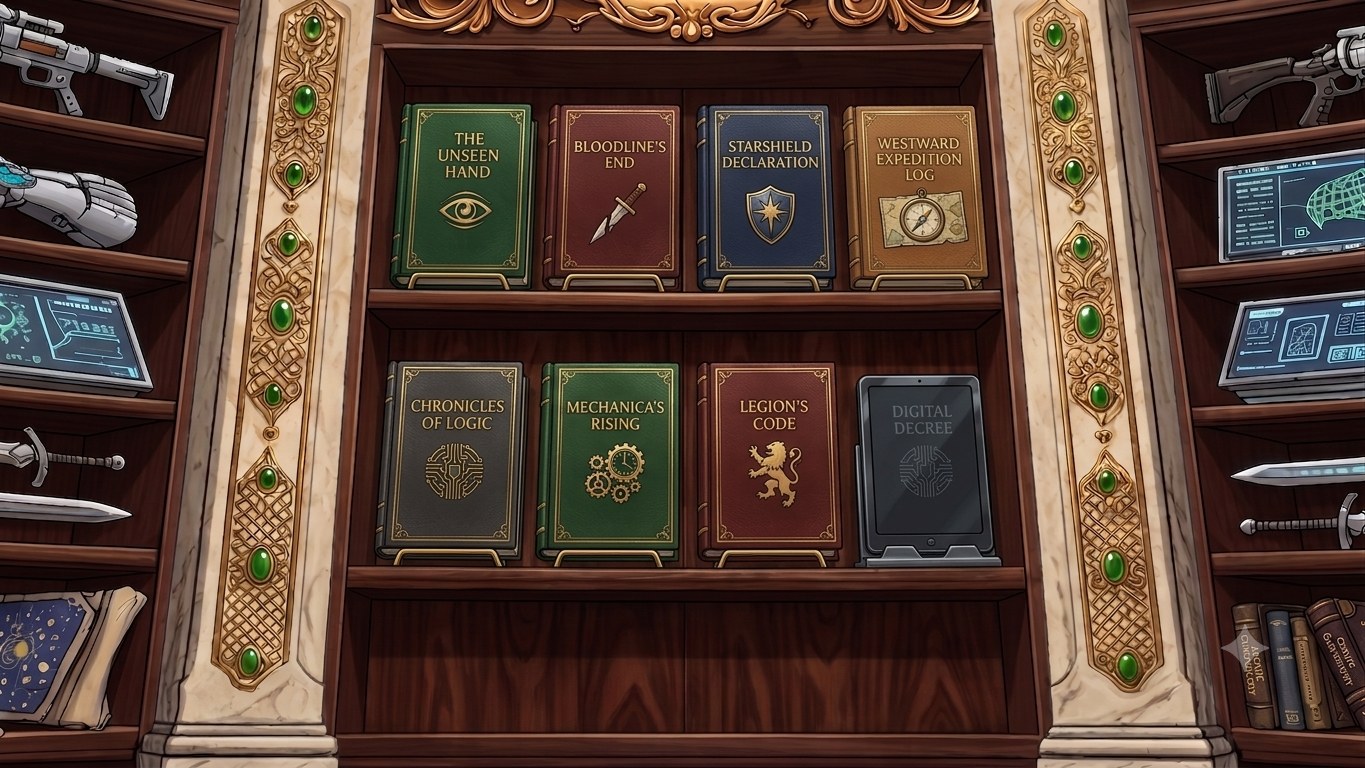
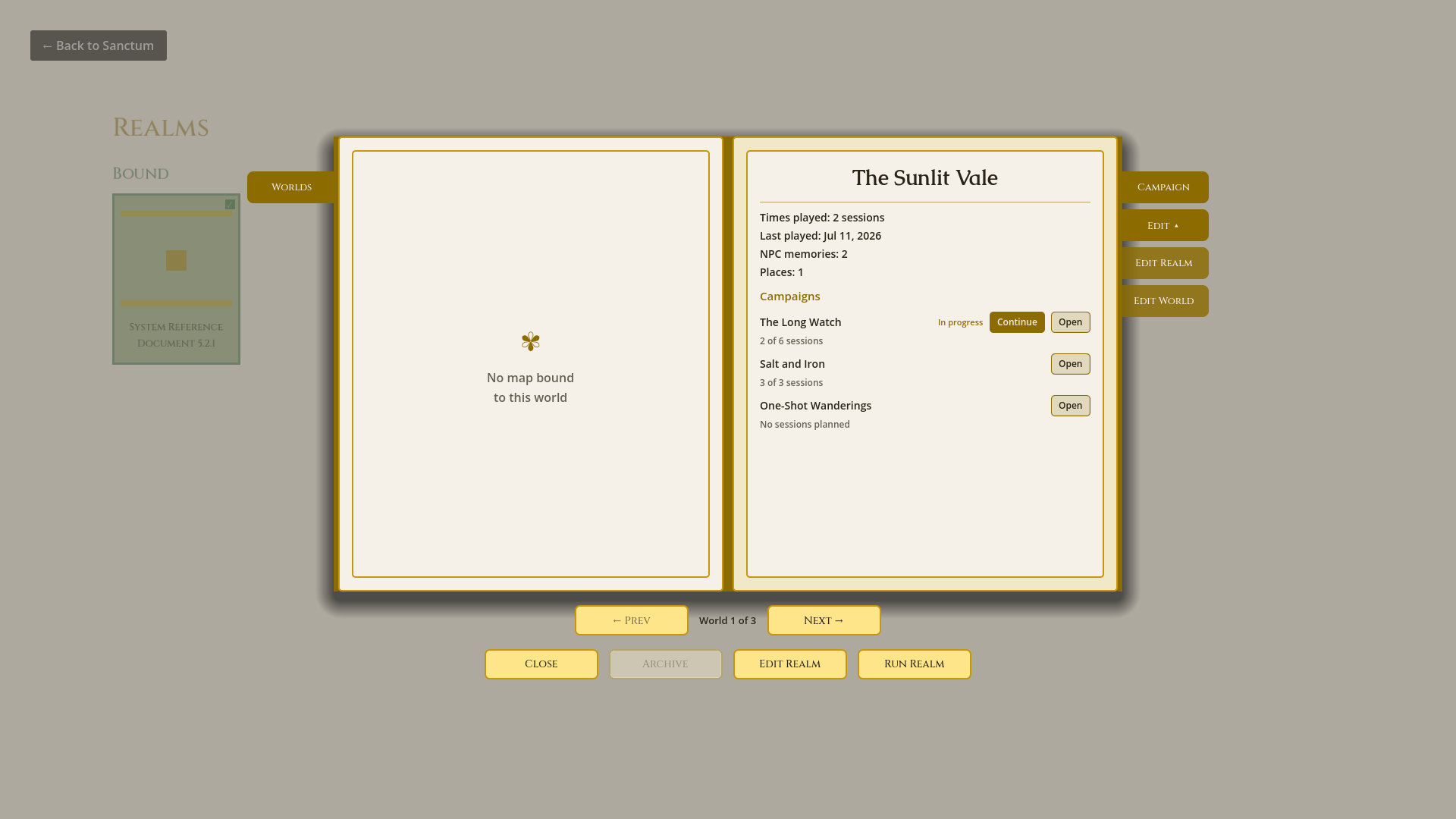
This is how RPGadget opens: not a file menu, a shelf. Each rulebook you import becomes a bound realm standing beside the others — fantasy tomes next to sci-fi slates next to your own homebrew. Take one down and the whole application dresses itself in that world.

Realm vessels — every genre declares its own physical form: tome, ledger, datapad, case file, salvage binder. The shelf renders whatever the realm says it is.
Maps in one app. Notes in another. Character sheets in a third. Rules in a browser tab, dice in a chat bot, and the actual story in a notebook you can't find on Thursday.
Every one of those tools makes you type the same campaign in again.
Every screen below is the real application. No mockups, no renders — this is the software as it runs today.
Point RPGadget at a PDF of your rulebook. It doesn't just scrape the words — it reads the page the way you do. A red cell is a warning. A column position is a tier. A line between two boxes is a relationship. Four channels of meaning, read at once, on your own PC.
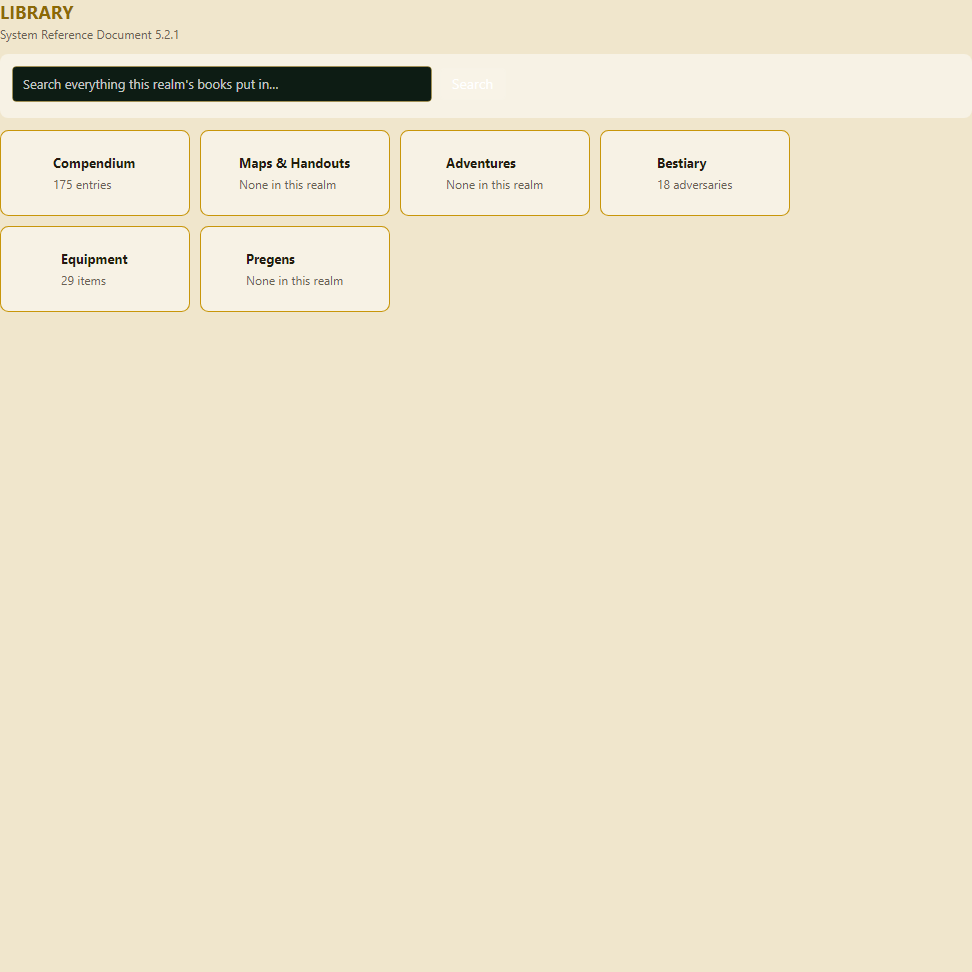
You review what it found, fix what it got wrong, and the book becomes a realm: rules, conditions, gear, adversaries, tables and lore, all queryable and all yours. Nothing is uploaded. Nothing is shipped with the app — your content comes from your book.
Every tool reads this. Alone, it isn't enough — the page carries more meaning than its sentences.
Red means danger. Which row, which column, which tier — where a thing sits is information.
Lines, arrows and brackets tie the page together — and most software is blind to them.
A realm is the whole game in one object: its rules, its dice, its conditions, its gear, its bestiary, its character options, its tone and its palette. RPGadget's engines know none of it by name — realms declare, engines render. That's why the next system you try doesn't need a new app.


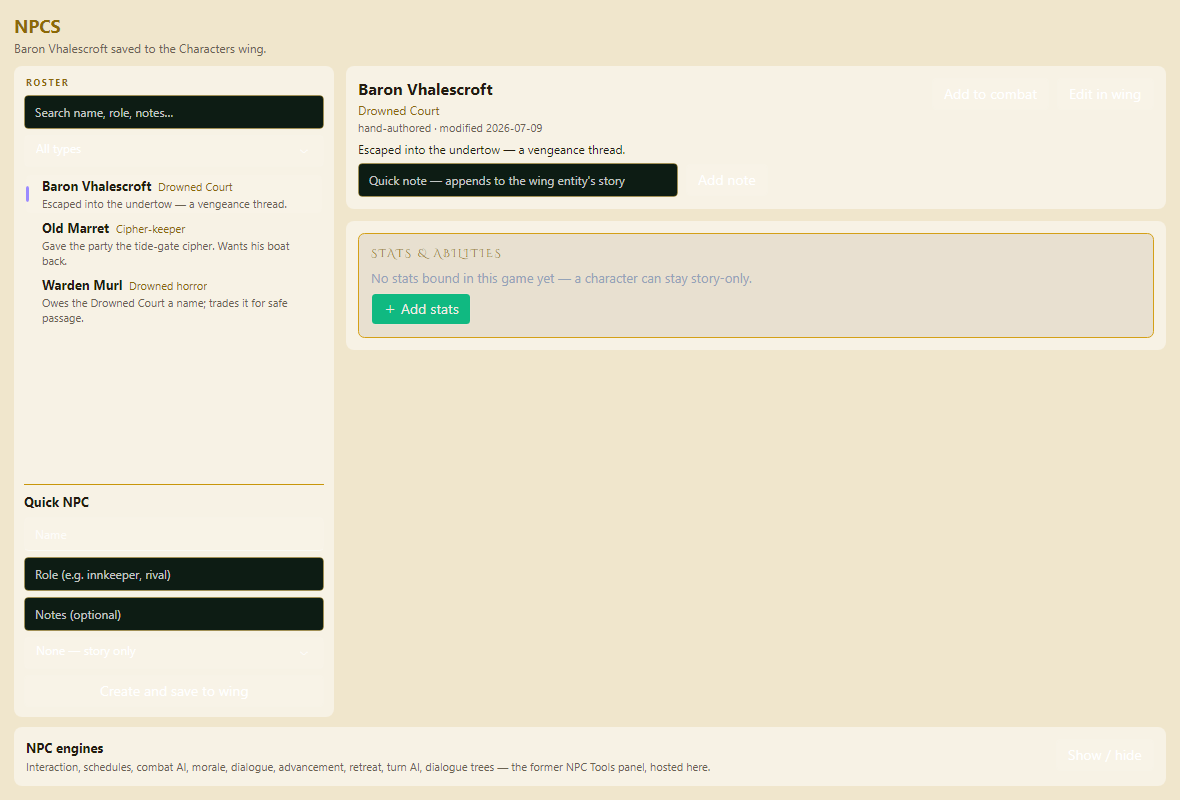
Worlds are permanent; campaigns live inside them. The barkeep your last group tipped is still behind the bar when the new group walks in — older, and with opinions about what happened. People, places, factions, history, economy, myth and rumour each have a wing, and every entry can point at every other.

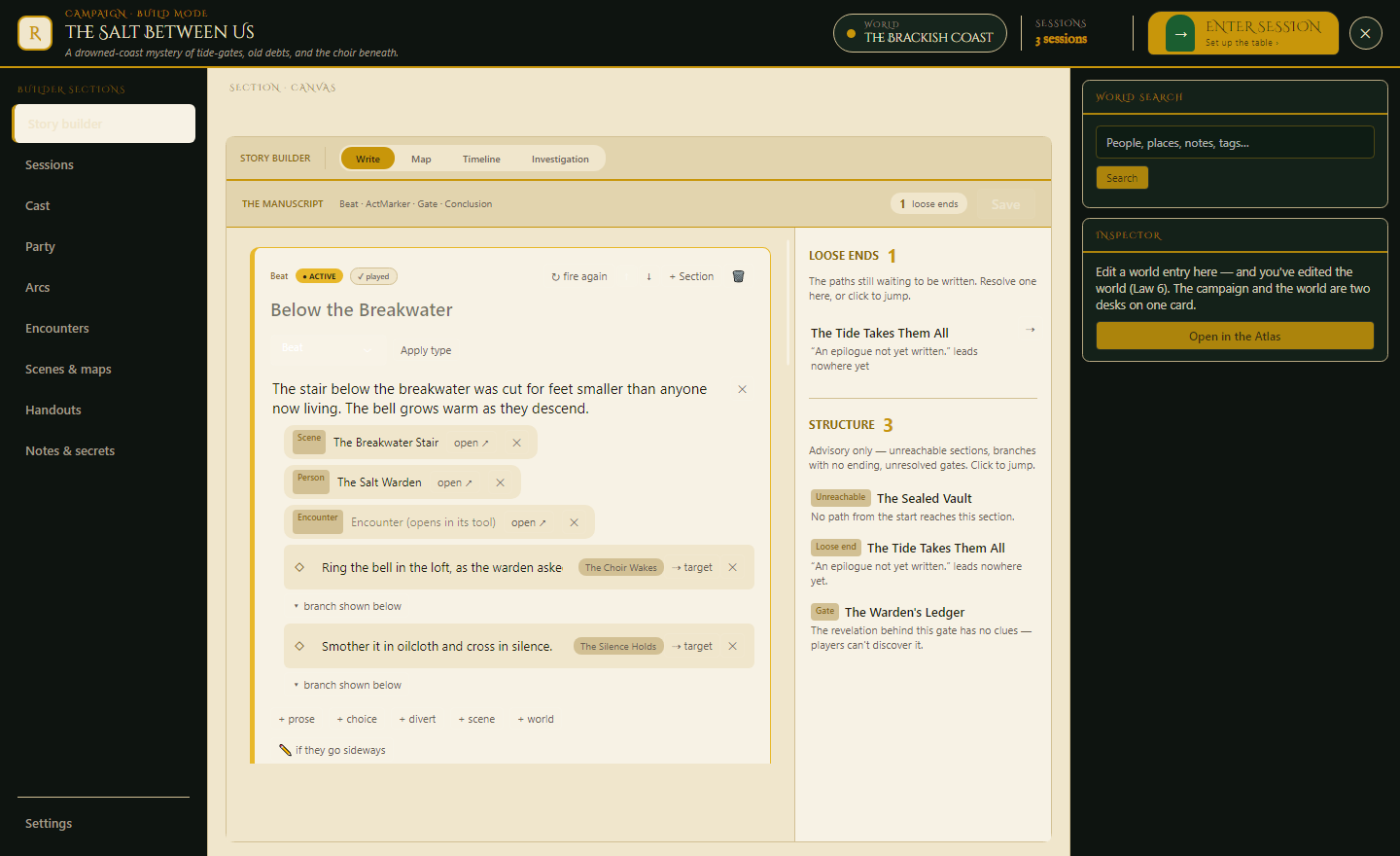
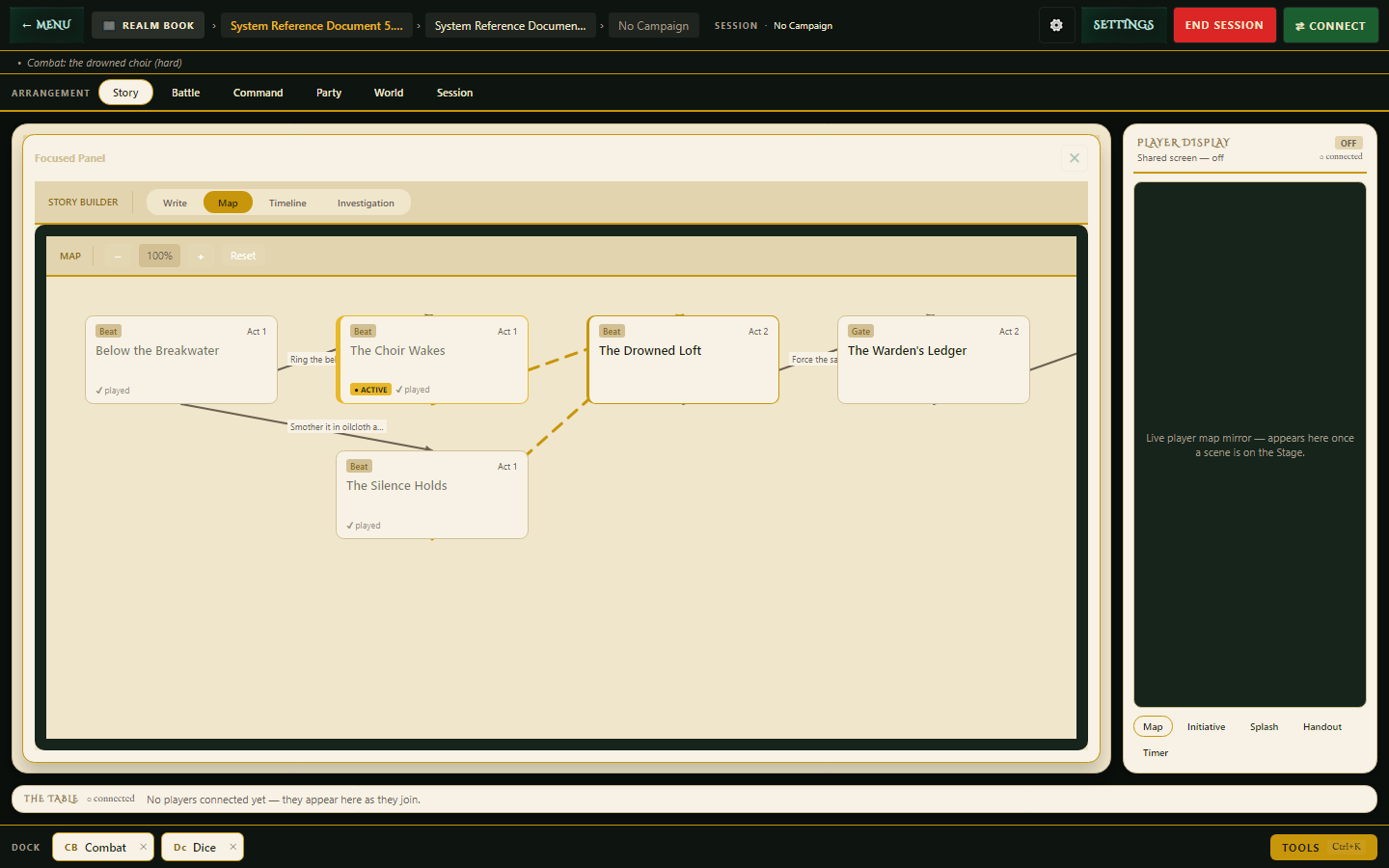
Lay out beats, branches, clocks and consequences on a board you can actually read at a glance. Every beat can hang an NPC, a place, a map, an encounter or a handout off it — so when the party turns left, the left-hand branch already has its people attached. Improvise anything; the board records what actually happened and carries it into the world's memory.


Draw maps yourself with real tools or generate a starting point and take it apart, then run them at the table with fog of war, tokens and a player view that shows only what you've revealed. Scenes, maps and handouts stage from the same place — push any of them to the second screen or to every player's browser the moment you want them seen.

Brushes, shapes, walls, doors, stamps and freehand. Generators are a starting point you can always overrule — never a black box.
World, region, settlement, site and tactical tiers — plus space tiers — with places on one tier opening into the tier below.
A second screen or TV showing exactly what the party can see, and nothing they can't.
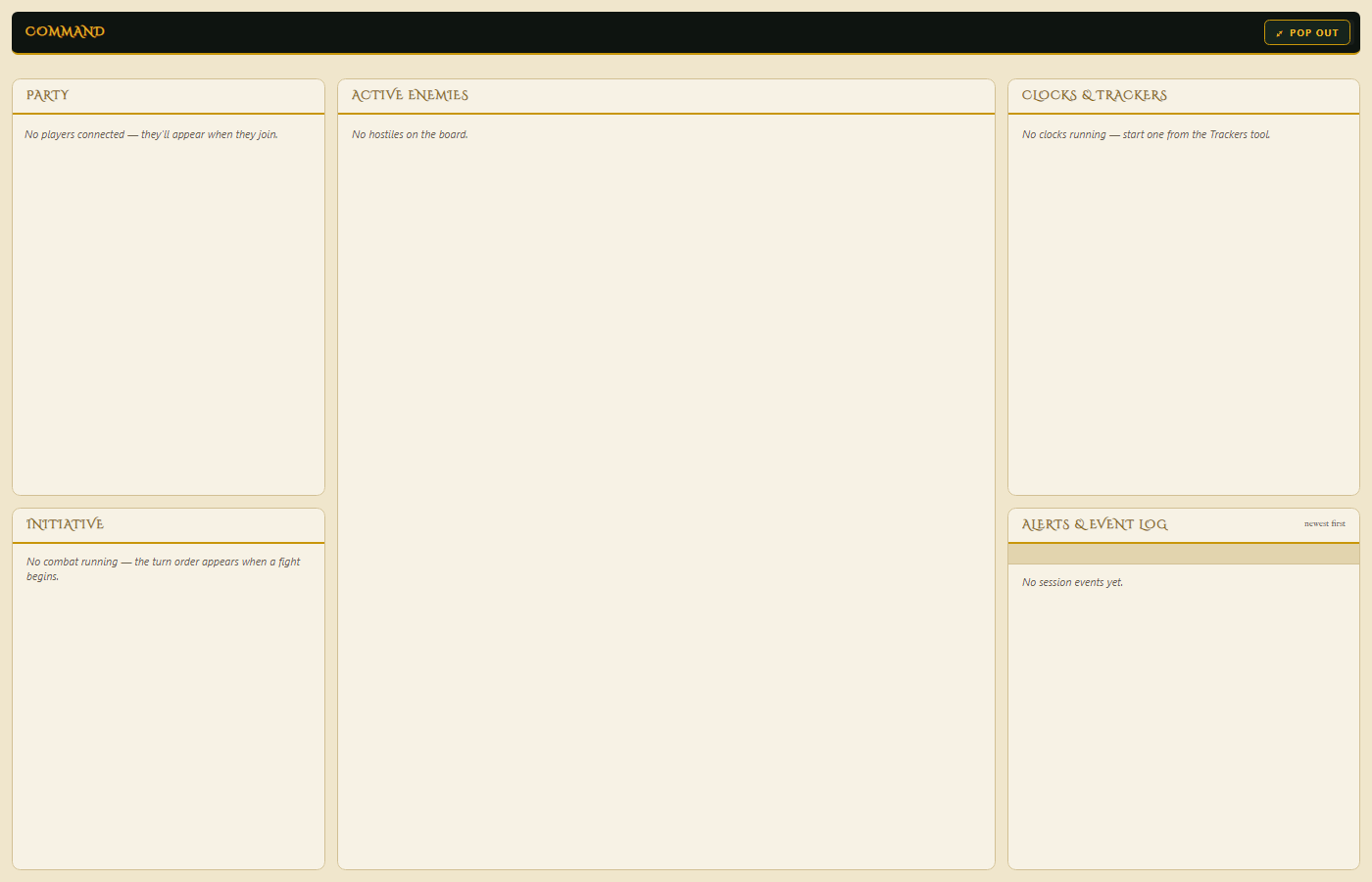
Session isn't a tab you open — it's a mode you enter. One workspace rearranges itself for what you're doing: command centre, battle, story, dice, trackers, journal. Press Ctrl+K to summon anything in the campaign by name. Nothing you prepared is more than a keystroke away.


Click the pedestal in the Sanctum and the Crafter rises out of it — a workbench of emerald light with the hall still visible through it. Twelve source slots that know what each book is. An extraction that shows its work in three bins, where nothing from your book is ever silently lost. A rules table that marks what came from the page and what came from you. And at the end, a binding: your realm descends to the shelf as a finished book.
The Crafter is in active design right now. These aren't screenshots — they're the live design concepts, and you can walk around inside each one:
The ghost of a realm-to-be hovers over twelve slots — each one knows whether it's holding a bestiary, a setting, or an adventure, and where its contents will flow.
Walk around it Interactive concept · 02Routed, needs-your-eye, and the pile. Every fragment of your book visibly accounted for — nothing deleted, everything rescuable.
Walk around it Interactive concept · 03The ceremony at the end: the finished book descends to the pedestal in a column of light, and the realm lands on your shelf.
Walk around itConcept — in development Design targets for the build, shown as-is.
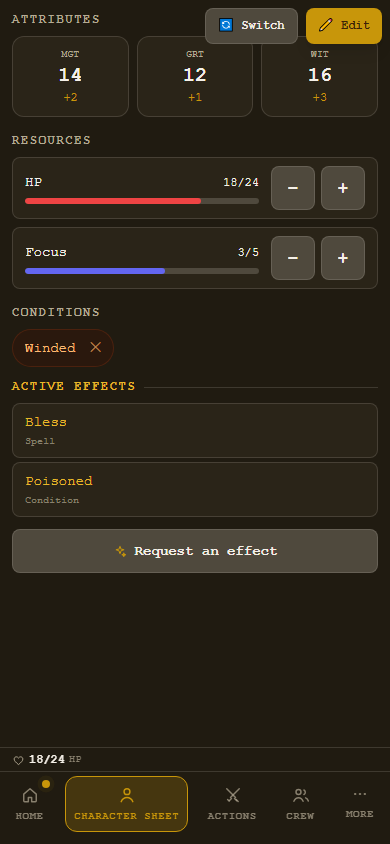
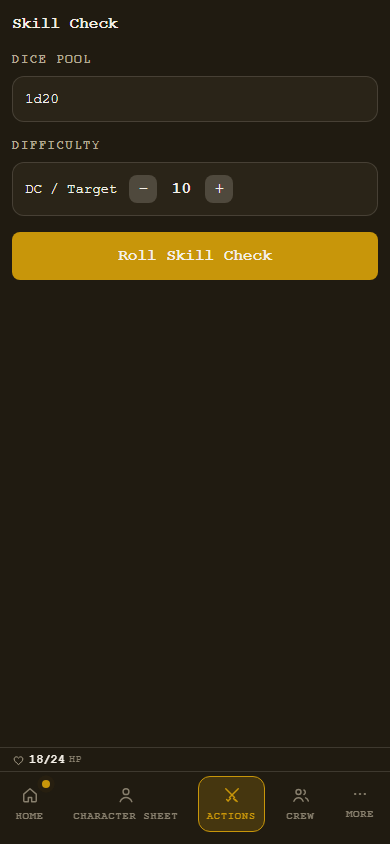
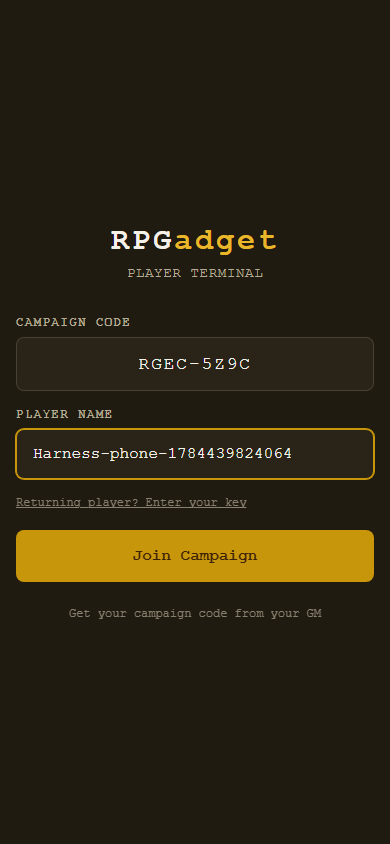
Players never install anything. They open a link on the phone already in their hand and they're in. The person on your sofa joins over your wifi with no internet at all; the friend who moved joins over the relay — including building their character days before the session, so game night starts with play instead of paperwork.
Their screen wears the realm's declared theme — the terminal look below belongs to this particular game, not to the app.


Everyone's phone talks straight to your PC. No internet, no account, no server between you and your friends. The router in the corner is the whole infrastructure.
Players anywhere join the same session over the internet, including pre-session character creation — proven live, phone to PC, across the country.
Every realm declares a theme — palette, type, texture, mood — and the GM shell and player screens both wear it. Nine genre themes ship today. This isn't a skin pack sold per title; it's how the engine works. Click a realm:
The neutral marble-and-gold gives way to whatever the realm declares — same engine, same renderers, different world.
d20, dice pools, narrative symbol dice, degrees of success. The realm declares how rolling works; the app rolls it.
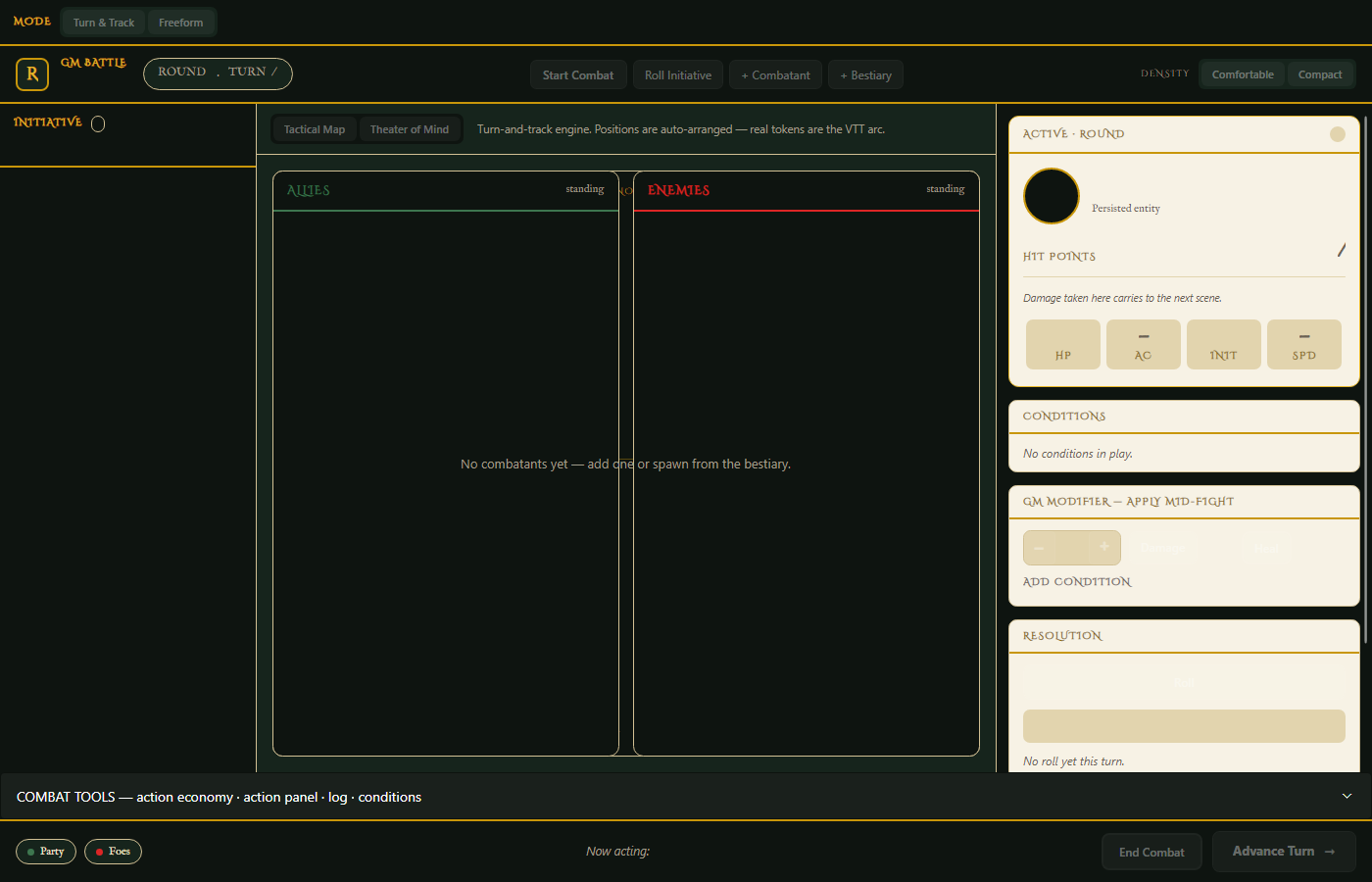
Turn-and-track combat and freeform action-consequence play — the shapes that cover most of the hobby.
Guided creation driven by the realm's own options — for you, or for players remotely before the session.
Build them by hand or draft them fast — with a memory of every table they've met.
Assemble adversaries, hazards and objectives, then drop the whole thing into a beat.
Treasure, trade and wealth — handed to players directly: whispers, loot drops, trades and targeted effects, all live.
Progress clocks, countdowns, initiative, conditions and anything else you need to remember mid-fight.
Session logs built from what actually happened, ready to read back next week.
Letters, maps and secrets — pushed to one player, some players, or the whole table.
Custom calendars, travel, seasons, and downtime that advances the world while the party rests.
Session zero, lines and veils, and a private way for anyone to pump the brakes.
Ctrl+K, type a name, get the NPC, rule, map, item or scene. The feature you'll use most.
| Typical VTT | Notes app | Single-system tool | RPGadget | |
|---|---|---|---|---|
| Works across systems | A few, unevenly | No rules at all | One, by design | Any — systems are data |
| Brings in your own book | Manual entry | Copy and paste | Licensed content only | Reads your PDF, structure and all |
| Prep and play in one place | Play only | Prep only | Partial | One continuous workflow |
| Persistent world memory | Per-campaign | Whatever you type | Rare | Worlds outlive campaigns |
| In-person table support | Built for remote | n/a | Varies | Same-wifi play with no internet |
| Where your data lives | Their servers | Their servers | Their servers | Your drive |
| Cost shape | Monthly, often per seat | Monthly | Monthly or per book | One purchase |
RPGadget is in active development ahead of a first release. An honest split of what already runs, what's being finished now, and what's next.

A serious long-term investment in the hobby, not another monthly drain.
No. Systems are expressed as data, so RPGadget supports many published games and homebrew alike. If your table changes games next year, your toolkit doesn't become obsolete.
The VTT is one chapter of many. RPGadget also covers importing your book, world building, story planning, NPCs, encounters, player support and live session management — connected, not bolted together.
RPGadget is a native Windows application for Windows 10 and 11. Players don't need Windows — they join from any browser on any phone, tablet or computer.
No, and that's deliberate. The app ships with no publisher's text inside it. Your library is built from the book you own and import, or from what you author yourself.
No. Players open a link on a phone, tablet or laptop. No player app, no player licence, no per-seat fee.
A session at your own table runs entirely on your local wifi, with no internet at all. The internet is only needed when someone joins from somewhere else — or builds a character remotely before you sit down.
No. Every feature is a complete manual tool first; assistance sits on top and is always optional and always editable. You stay the author.
Because the tools stop duplicating each other. One world feeds the story, the story feeds the session, the session feeds the journal, and none of it needs typing in twice.
Bring your book in. Build the world. Seat the table. Run the night.
Launch news, screenshots and beta invitations. Nothing else.